
Research
The Trust invites wildlife veterinarians and wildlife ecologists to submit disease surveillance or research project proposals. These proposals will be considered by the Trust Steering Committee, who will consult with Parks and Wildlife Management Authority (PWMA) and the State Wildlife Veterinary Unit (WVU). If the outcome of the research is deemed important enough to influence management decisions in the area, the Trust will aim to raise funds on behalf of the researchers, or provide the necessary equipment and facilities to complete the project.
A project is more likely to be approved if it focuses on a Trans Frontier Conservation Area (TFCA). TFCAs, or 'peace parks', are large tracts of land designated for conservation that span international borders. Zimbabwe is involved in 6 of these initiatives: Great Limpopo TFCA; Greater Mapungubwe (formerly Limpopo-Shashe) TFCA; Kavango-Zambezi TFCA; Mana-Lower Zambezi TFCA; Chimanimani TFCA and ZiMoZa TFCA.
Publications resulting from AWARE's collaborations:
- Dhliwayo, S., Matope, G., Marabini, L., Dutlow, K. & Pfukenyi, D.M., 2012, ‘Seroprevalence of leptospirosis in dogs in urban Harare and selected rural communities in Zimbabwe’, Onderstepoort Journal of Veterinary Research 79(1)
- Chinyoka, S., Dhliwayo, S., Marabini, L., Dutlow, K., Matope, G. Pfukenyi, D.M., 2014, ‘Serological survey of Brucella canis in dogs in urban Harare and selected rural communities in Zimbabwe’, Journal South African Vet Association, Apr 7;85(1):1087. doi: 10.4102/jsava.v85i1.1087
- Patrick Kelly, Lisa Marabini, Keith Dutlow, Jilei Zhang, Amanda Loftis, Chengming Wang, 2014, ‘Molecular detection of tick-borne pathogens in captive wild felids, Zimbabwe’, Parasites and Vectors Nov 2014
- Kobeni, S.; Osthoff, G.; Madende, M.; Hugo, A.; Marabini, L. The Dynamic Changes of African Elephant Milk Composition over Lactation. Animals 2020, 10, 948.
Buffalo disease surveillance in Mana Pools 2012
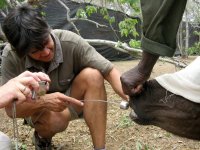 In December 2012 AWARE Trust was commissioned by the SADC-FMD Programme to perform FMD testing and disease surveillance in buffalo herds in Mana Pools, and in cattle herds in the communal lands adjacent to Mana Pools. The cattle testing was performed prior to the buffalo work to prevent any possible accidental introduction of the virus from the buffalo to the cattle. Narrowly missing the start of the rainy season, a boma was set up near the Mana river mouth and buffalo were driven into the boma by a helicopter. After resting in the boma overnight a sample of 25 target animals (under the age of 2 years) were darted the following day. Once immobilised, the animals were bled, and sampled with a probang (which collects pharyngeal epithelium in which the FMD virus thrives). These samples were immediately frozen in liquid nitrogen to preserve the virus. Other samples were also taken opportunistically. The most difficult part of the project was finding a carrier willing to transport the samples in liquid nitrogen into South Africa. All samples were eventually sent to Onderstepoort Veterinary Institute. The results are still pending.
No FMD in LSTFCA cattle
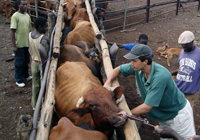
In 2008, AWARE secured funding from the SADC FMD Program and performed a Foot and Mouth Disease (FMD) survey in 5% of the cattle in the proposed Limpopo-Shashe Trans-Frontier Conservation Area (LS-TFCA). The project was performed on behalf of the Department of Livestock and Veterinary Services and in conjunction with vet department field staff in the area. The LS-TFCA is in the South-West corner of Zimbabwe where borders are shared with both South Africa and Botswana. The Maramani communal land is directly adjacent to the junction of the Shashe and Limpopo Rivers, where all 3 countries meet, and is therefore destined to become part of the TFCA. It is thus important to know the disease status of cattle within this area because it has major implications for the future direction of the LS-TFCA. Results show that this population has not been exposed to FMD recently.